
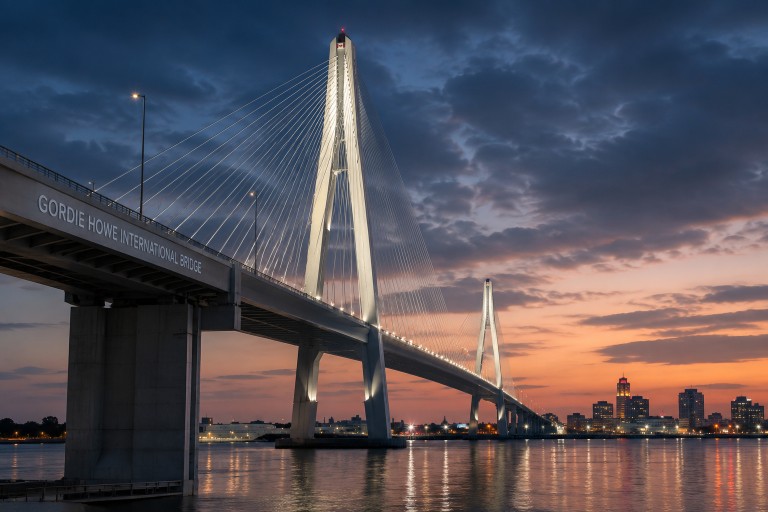
The inauguration ceremony for the Gordie Howe International Bridge, planned as a joint event between Canada and the United States, has been called off by Canada in response to the U.S. announcing a proposed 50% tariff on a wide range of Canadian goods. This development adds to the existing trade tensions between the two neighboring countries. Canadian authorities deemed it unsuitable to hold a joint celebration given these circumstances, opting instead to host an independent event. The U.S. has yet to confirm whether it will proceed with its own ceremony.
Despite this diplomatic hiccup, both nations continue to target July 27 for the opening of the bridge to traffic. The bridge, which stretches 2.4 kilometers, links Detroit, Michigan, and Windsor, Ontario, and is poised to serve as a crucial conduit for trade and transportation between the U.S. and Canada. The bridge’s construction commenced in 2018 and has incurred costs of nearly $4.4 billion, with Canada funding the project. This investment is expected to be recouped through toll revenues, under an agreement that includes sharing 50% of net bridge and crossing-related revenues with a U.S.-controlled economic development fund, a decision that has faced criticism from opposition lawmakers in Canada.
The cancellation of the joint ceremony comes in the wake of U.S. President Donald Trump’s announcement of new tariffs on Canadian imports. These tariffs target various sectors, including automobiles, alcohol, and dairy products. Scheduled to be implemented in 30 days, these tariffs leave a window for possible negotiations to avert them.
In response to the escalating trade dispute, Canadian Prime Minister Mark Carney has reiterated his government’s commitment to maintaining free and fair trade while engaging in dialogues with the U.S. On the other hand, Ontario Premier Doug Ford has suggested that Canada should impose equivalent tariffs if the U.S. goes ahead with its proposed measures.